
 Photo: Pachon in Motion / Pexels
What is Quantum Computing Applications? Unlocking Tomorrow's Tech
Dive deep into the groundbreaking applications of quantum computing that are set to redefine technological capabilities.
Explore Quantum's FutureKey Takeaways
- ✓ Quantum computing leverages quantum-mechanical phenomena like superposition and entanglement.
- ✓ It promises to solve problems intractable for classical computers, impacting various sectors.
- ✓ Key application areas include drug discovery, materials science, financial modeling, and AI.
- ✓ The technology is still in its nascent stages but is rapidly advancing with significant investments.
How It Works
Unlike classical bits (0 or 1), quantum bits (qubits) can exist in multiple states simultaneously (superposition). This allows for exponentially more information processing.
Entanglement links qubits such that the state of one instantly influences another, regardless of distance. This creates powerful computational shortcuts not possible classically.
Specialized algorithms are designed to exploit superposition and entanglement to solve specific problems. Shor's algorithm for factoring and Grover's for searching are prime examples.
By manipulating qubits and their quantum states, quantum computers can explore vast solution spaces far more efficiently. This capability addresses problems currently beyond classical computational limits.
Understanding the Foundation: What Makes Quantum Computing Unique?
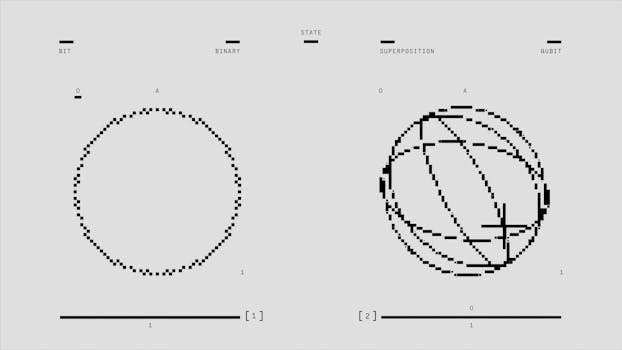 Photo: Google DeepMind / Pexels
Quantum computing, on the other hand, operates on an entirely different paradigm, leveraging the peculiar rules of quantum mechanics. The foundational unit here is the quantum bit, or qubit. Unlike a classical bit, a qubit can exist in a superposition of states, meaning it can be 0, 1, or a combination of both simultaneously. Imagine a coin spinning in the air – it's neither heads nor tails until it lands. A qubit is similar, holding multiple possibilities at once. This property alone dramatically expands the computational power available, allowing a quantum computer to process vast amounts of information in parallel.
Another critical quantum phenomenon is entanglement. When two or more qubits become entangled, they are intrinsically linked, sharing the same fate regardless of the physical distance separating them. If you measure the state of one entangled qubit, you instantly know the state of the others. This non-local correlation is a profound resource for quantum computation, enabling complex calculations and interdependencies between qubits that have no classical analogue. It's like having a network of interconnected components where the state of one immediately informs the others, creating a highly efficient system for solving intricate problems.
Finally, quantum interference plays a vital role. Just as waves can interfere constructively or destructively, quantum states can interfere with each other. Quantum algorithms are designed to amplify correct answers and cancel out incorrect ones, guiding the computation towards the desired solution more efficiently. These three pillars – superposition, entanglement, and interference – are the bedrock upon which all quantum computing applications are built. They allow quantum machines to tackle problems that are simply intractable for classical computers, opening doors to scientific discoveries and technological advancements previously considered impossible. Understanding these core principles is the first step in appreciating the transformative potential of this emerging technology. The ability to manipulate these quantum states is what gives quantum computers their unprecedented power and distinguishes them from even the most advanced classical supercomputers. This fundamental difference is why we are on the cusp of a computational revolution.
Revolutionizing Industries: Diverse Quantum Computing Applications
 Photo: ThisIsEngineering / Pexels
In the realm of healthcare and pharmaceuticals, quantum computing holds immense promise for drug discovery and materials science. Developing new drugs is an incredibly lengthy and expensive process, often taking over a decade and billions of dollars. Quantum computers can simulate molecular interactions with unprecedented accuracy, allowing researchers to model complex chemical reactions, predict protein folding, and design new materials with specific properties at an atomic level. This could drastically reduce the time and cost associated with bringing life-saving medications to market, enabling personalized medicine and developing cures for currently untreatable diseases. Imagine simulating the behavior of a new drug candidate with perfect fidelity before ever synthesizing it in a lab.
Financial services stand to benefit significantly from quantum applications. Quantum algorithms can optimize complex financial models, enabling more accurate risk assessment, fraud detection, and portfolio optimization. For example, quantum annealing could help financial institutions analyze vast datasets to identify market trends and make more informed trading decisions, potentially leading to increased profitability and reduced financial risk. The ability to process and analyze massive amounts of data at speeds impossible for classical computers will provide a significant competitive edge.
Manufacturing and logistics are another prime area for quantum innovation. Supply chain optimization is a notoriously difficult problem, involving countless variables and constraints. Quantum algorithms can find optimal routes, manage inventory, and schedule production more efficiently, leading to reduced costs and increased operational efficiency. This could mean fewer delays in shipping, more efficient resource allocation, and a significant boost to global trade. Companies like Volkswagen are already exploring quantum solutions for traffic optimization, aiming to reduce congestion and improve urban mobility.
Artificial intelligence and machine learning are also set for a quantum leap. Quantum machine learning (QML) algorithms could process larger datasets, identify more complex patterns, and train AI models more efficiently than their classical counterparts. This could lead to breakthroughs in areas like image recognition, natural language processing, and personalized recommendations, creating more intelligent and adaptable AI systems. The sheer computational power of quantum machines could enable AI to tackle problems currently out of reach.
Furthermore, cybersecurity is a critical field where quantum computing presents both a threat and a solution. Shor's algorithm, for instance, could theoretically break many of the encryption methods currently used to secure online communications. However, quantum cryptography and post-quantum cryptography are emerging fields developing new encryption techniques that are resistant to quantum attacks, ensuring the continued security of our digital infrastructure. The race is on to develop quantum-safe encryption before powerful quantum computers become widely available. The versatility of what is quantum computing applications makes it a truly transformative technology.
Challenges and the Road Ahead for Quantum Computing Applications
Photo: Pachon in Motion / PexelsOne of the primary challenges is error correction. Qubits are fragile, and even minor disturbances can cause 'decoherence,' where the quantum state collapses, leading to computational errors. Developing robust error-correction techniques is crucial for scaling up quantum computers to perform complex, reliable calculations. Researchers are actively working on fault-tolerant quantum computing, which involves encoding information redundantly across multiple physical qubits to protect against errors. This is a monumental engineering feat, requiring significant advancements in materials science and quantum control.
Another hurdle is the development of practical quantum algorithms. While theoretical algorithms like Shor's and Grover's demonstrate the power of quantum computing, designing efficient algorithms for real-world problems remains a complex task. It requires a deep understanding of both quantum mechanics and the specific problem domain. The current generation of quantum programmers is a specialized group, and there's a need to develop more accessible programming tools and languages to broaden the community of quantum developers. The ecosystem for quantum software is still maturing, and user-friendly interfaces are vital for wider adoption.
The scalability of quantum hardware is also a major concern. Building a quantum computer with hundreds or thousands of stable, interconnected qubits is incredibly difficult. Different architectural approaches, such as superconducting qubits, trapped ions, photonic qubits, and topological qubits, are being explored, each with its own advantages and disadvantages. The race to achieve 'quantum supremacy' – where a quantum computer performs a task provably beyond the capabilities of any classical computer – has been met, but demonstrating practical, useful quantum advantage for real-world problems is the next significant milestone.
Investment in quantum research and development is soaring globally, with governments, academic institutions, and tech giants pouring resources into advancing the field. Companies like IBM, Google, Microsoft, and Amazon are leading the charge, developing their own quantum hardware and cloud platforms to make quantum computing accessible to researchers and developers. This collaborative effort, coupled with rapid advancements in quantum physics and engineering, suggests that while challenges are significant, they are not insurmountable. The journey towards fully realizing the potential of what is quantum computing applications is a long one, but the progress being made is undeniable and exciting. The development of new quantum technologies continues at a rapid pace, pushing the boundaries of what we thought was possible.
Navigating the Quantum Landscape: Tips for Businesses and Researchers
 Photo: Nicolas Foster / Pexels
1. Start Learning Now, Experiment Early: Don't wait for quantum computers to become fully mature. Begin educating your teams about quantum principles, algorithms, and potential use cases. Many cloud-based quantum platforms (e.g., IBM Quantum Experience, Amazon Braket) offer access to quantum simulators and even real quantum hardware. Experiment with small-scale problems relevant to your industry to gain hands-on experience and identify potential quantum advantages. This early engagement can provide a significant competitive edge.
2. Identify 'Quantum-Ready' Problems: Not every problem is suitable for quantum computing. Focus on identifying specific, computationally intensive problems within your organization that are currently intractable for classical computers and align with known quantum algorithm strengths (e.g., optimization, simulation, machine learning on complex data). Prioritize problems where even a modest quantum advantage could yield substantial value.
3. Build a Hybrid Quantum-Classical Strategy: For the foreseeable future, quantum computers will likely work in conjunction with classical supercomputers. Develop strategies that leverage the strengths of both. Quantum processors can handle specific, complex sub-routines, while classical computers manage overall orchestration and data pre/post-processing. This hybrid approach is key to extracting value in the NISQ era.
4. Invest in Talent and Collaboration: The quantum talent pool is small but growing. Invest in training existing employees or recruiting individuals with expertise in quantum physics, computer science, and mathematics. Collaborate with universities, research institutions, and quantum computing startups. Partnerships can provide access to cutting-edge research, specialized expertise, and shared resources, accelerating your quantum journey.
5. Address Security Implications: Be aware of the potential cybersecurity threats posed by future quantum computers to current encryption standards. Start exploring post-quantum cryptography solutions and develop a roadmap for transitioning your data and systems to quantum-safe encryption. Proactive measures are essential to protect sensitive information from future quantum attacks.
6. Manage Expectations: Quantum computing is a long-term play. While the potential is enormous, practical, disruptive applications are still years, if not decades, away for many complex problems. Avoid hype and focus on realistic timelines and achievable milestones. Celebrate incremental progress and view early experiments as learning opportunities rather pouches of immediate, revolutionary breakthroughs.
By following these tips, businesses and researchers can strategically position themselves to harness the transformative power of what is quantum computing applications, preparing for a future where quantum capabilities become an integral part of technological innovation. The journey into the quantum realm requires foresight, patience, and a commitment to continuous learning and adaptation.
Comparison
| Feature | Quantum Computing | Classical Supercomputing | Traditional PC |
|---|---|---|---|
| Computational Paradigm | Qubits, Superposition, Entanglement | Bits (0s and 1s) in parallel | Bits (0s and 1s) sequentially |
| Problem Solving Strength | Optimization, Simulation, AI (complex) | Data processing, Large-scale simulations | General purpose tasks, Everyday applications |
| Scalability | Challenging (qubit stability) | High (processor cores) | Moderate (clock speed, RAM) |
| Error Correction | Highly complex, active research | Well-established | Well-established |
| Energy Consumption | High for cooling/control, low for computation | Very high | Moderate |
| Current Availability | Cloud access, R&D labs | Specialized data centers | Widespread |
What Our Readers Say
"Understanding what is quantum computing applications has completely reshaped my research in materials science. The ability to simulate molecular structures with such precision is groundbreaking, accelerating our discovery process exponentially."
Dr. Elena Petrova Boston, MA"As a financial analyst, the potential for quantum algorithms to optimize complex portfolios is simply astounding. It promises a level of market insight and risk management that's currently unattainable with classical methods."
Mark Chen San Francisco, CA"Our logistics company started exploring what is quantum computing applications for supply chain optimization. Early simulations show a potential 15% reduction in shipping costs, a concrete result that could redefine our operational efficiency."
Sarah Jenkins Austin, TX"While still in its early stages, the foundational principles of quantum computing are undeniably powerful. I'm excited by the progress, though I recognize the journey to widespread practical applications will take time and further innovation."
David Miller Seattle, WA"Working in pharmaceutical R&D, what is quantum computing applications offers a beacon of hope for drug discovery. Simulating protein folding with quantum accuracy could unlock treatments for diseases previously deemed incurable."
Aisha Rahman New York, NYFrequently Asked Questions
What are the most promising quantum computing applications?
Is quantum computing going to replace classical computers?
How can I start learning about quantum computing applications?
What is the current cost of quantum computing?
How does quantum computing compare to supercomputing?
Who should consider utilizing quantum computing applications?
What are the risks associated with quantum computing applications?
What does the future hold for quantum computing applications?
The world is on the cusp of a quantum revolution. By understanding what is quantum computing applications, you can prepare to harness its power and drive innovation in your field. Embrace the future of technology today.