
The Future of Virtual Reality Gaming: Beyond Your Wildest Dreams
Prepare to dive into an unprecedented era of gaming where the lines between reality and virtual worlds blur completely.
Explore the FutureKey Takeaways
- ✓ VR gaming market projected to reach over $50 billion by 2028.
- ✓ Haptic technology is evolving to provide full-body tactile sensations.
- ✓ Eye-tracking and foveated rendering will significantly boost VR performance.
- ✓ The metaverse is poised to integrate VR gaming into persistent virtual worlds.
How It Works
Future VR headsets will feature higher resolutions, wider fields of view, and lighter designs, often incorporating micro-LED or OLED panels. This will deliver unparalleled visual fidelity, reducing screen-door effect and motion sickness for a truly seamless visual experience.
Beyond visual and auditory, haptic feedback will become a core component, simulating touch, impact, and even temperature. Special suits and gloves will allow players to feel rain, sword clashes, or the texture of virtual objects, dramatically increasing presence.
Next-gen VR will move beyond traditional controllers. Brain-computer interfaces (BCIs), advanced hand tracking, and even full-body tracking will allow for more natural, nuanced interactions. This means controlling games with thoughts or gestures, making gameplay incredibly intuitive.
The integration of VR gaming into the broader metaverse concept will create persistent, interconnected virtual worlds. Players will not only game but also socialize, work, and create within these shared digital spaces, fostering vibrant online communities and economies.
Unlocking Unprecedented Realism: The Visual and Auditory Revolution in VR Gaming
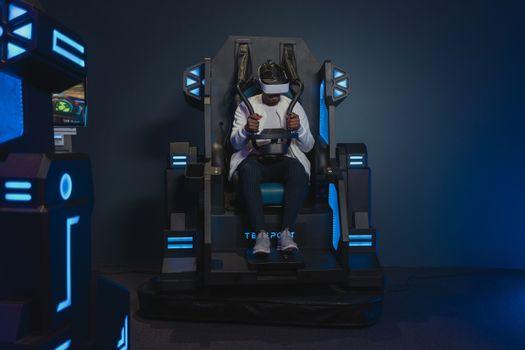 Photo: Tima Miroshnichenko / Pexels
Beyond Sight and Sound: The Rise of Haptic Feedback and Multi-Sensory Immersion
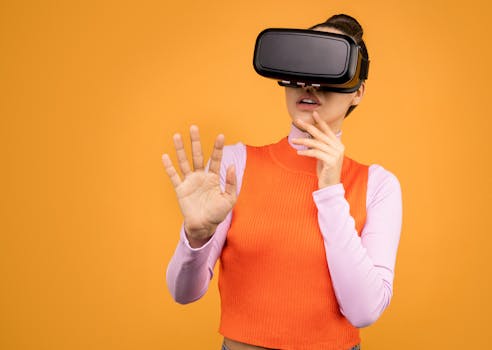 Photo: Sound On / Pexels
Seamless Interaction: Brain-Computer Interfaces and the Evolution of Control in VR
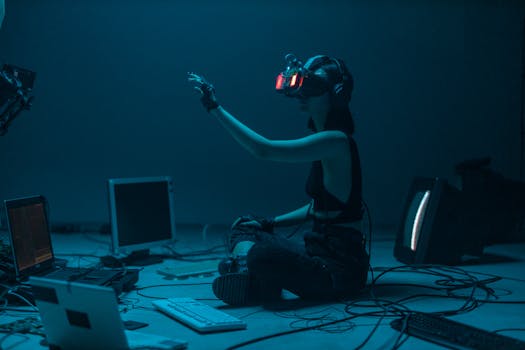 Photo: cottonbro studio / Pexels
The Metaverse and Beyond: Persistent Worlds and the Social Future of VR Gaming
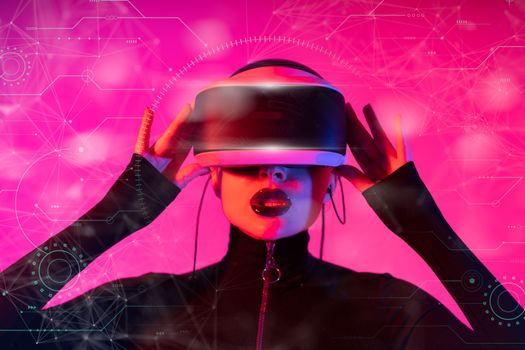 Photo: Atlantic Ambience / Pexels
Comparison
| Feature | Future VR Gaming | Current High-End VR | Traditional Gaming |
|---|---|---|---|
| Visual Fidelity | Photorealistic (8K+ per eye) | Very High (2-4K per eye) | High (on 2D screen) |
| Haptic Feedback | Full-body, multi-sensory | Limited (controller rumble) | None |
| Interaction | BCI, full-body tracking, advanced hand/eye tracking | Controller, basic hand tracking | Controller, keyboard/mouse |
| Immersion Level | Full sensory presence | High (visual/audio) | Visual/audio |
| Social Interactivity | Persistent metaverse, realistic avatars | Lobbies, basic avatars | Chat, voice comms |
| Physical Space | Large-scale roomscale/mixed reality | Roomscale/standing | Seated |
What Readers Say
"The potential for the future of virtual reality gaming is mind-blowing. I can't wait for the day I can truly step into a game and feel every sensation. It's going to redefine entertainment."
Alex Chen · Seattle, WA"I'm already impressed with current VR, but the idea of full-body haptics and eye-tracking makes me so excited. My gaming experiences are about to get a serious upgrade in immersion."
Maria Rodriguez · Austin, TX"As a developer, the advancements discussed here are inspiring. We're moving towards a future where games aren't just played, but truly lived. It's going to open up entirely new creative possibilities for storytelling and interaction."
David Lee · New York, NY"While the technology sounds amazing, I'm curious about the accessibility and cost. I hope these incredible advancements become affordable for the average gamer, not just a niche market. Still, the promise is undeniable."
Sarah Miller · Denver, CO"My kids tried VR for the first time recently, and their jaws dropped. Imagine what they'll experience in 10-15 years with these future technologies. It's going to be transformative for how they interact with digital content, far beyond just gaming."
John Smith · Los Angeles, CAFrequently Asked Questions
What are the biggest technological leaps expected in the future of virtual reality gaming?
The biggest leaps will be in display technology (higher resolution, wider FOV, foveated rendering), haptic feedback (full-body suits, nuanced tactile sensations), and interaction methods (advanced hand/eye tracking, brain-computer interfaces). These combined will create an unprecedented level of sensory immersion and natural control, making virtual worlds feel indistinguishable from reality.
Will VR gaming be affordable for the average consumer in the future?
While initial cutting-edge VR technology will likely be premium-priced, the history of consumer electronics suggests that costs will decrease significantly over time due to mass production, competition, and technological efficiencies. More accessible, feature-rich headsets and accessories are expected to become widely available, making advanced VR gaming a mainstream entertainment option.
How will brain-computer interfaces (BCIs) change VR gaming?
BCIs could revolutionize VR gaming by allowing players to control games directly with their thoughts, eliminating the need for physical controllers. This could enable instantaneous actions, highly intuitive navigation, and a deeper sense of connection to the virtual avatar. Early applications might focus on accessibility or subtle commands, gradually expanding as the technology matures and becomes more refined.
What is the role of the metaverse in the future of VR gaming?
The metaverse is envisioned as a persistent, interconnected digital universe where VR gaming will be an integral component. Instead of playing isolated games, users will move between shared virtual worlds for gaming, socializing, work, and creation. This will foster vibrant communities, enable user-generated content, and potentially introduce new economic models like play-to-earn, blurring the lines between gaming and digital life.
How will future VR gaming compare to traditional console or PC gaming?
Future VR gaming is expected to offer a fundamentally different experience. While traditional gaming focuses on a 2D screen, VR provides a full 360-degree, multi-sensory immersion, making you feel physically present in the game world. The integration of advanced haptics, intuitive controls, and social metaverse experiences will elevate VR beyond what traditional gaming can offer in terms of presence and sensory engagement.
Who should be excited about the future of virtual reality gaming?
Anyone interested in cutting-edge entertainment, immersive storytelling, and new forms of social interaction should be excited. Gamers looking for unparalleled realism, developers seeking new creative canvases, and individuals curious about the next frontier of digital experience will find the future of VR gaming incredibly compelling. It promises to transform how we play, learn, and connect.
Are there any potential risks or ethical concerns with advanced VR gaming?
As VR technology advances, particularly with BCIs and hyper-realism, ethical concerns around data privacy, mental health (e.g., addiction, reality dissociation), and the potential for misuse (e.g., deepfakes, psychological manipulation) will become more prominent. Developers and policymakers will need to establish robust ethical guidelines and safeguards to ensure responsible and beneficial development.
What kind of games will thrive in this advanced VR future?
Games that leverage true immersion will thrive. This includes highly realistic simulations (flight, racing, surgery), expansive open-world RPGs, innovative social experiences, and physically demanding action games that benefit from full-body tracking. Any genre that can be enhanced by a feeling of 'being there' and natural interaction will see a significant evolution and expansion.
The future of virtual reality gaming isn't just about incremental improvements; it's about a complete paradigm shift in how we interact with digital worlds. Prepare to step beyond the screen and into experiences that will redefine entertainment, challenge your perceptions, and connect you with others in ways previously unimaginable. The next chapter of gaming is about to unfold, and it's more immersive than you could ever dream.