✓ Quantum computers use 'qubits' which can be 0, 1, or both simultaneously (superposition).
✓ They leverage 'entanglement' to link qubits, allowing for exponential processing power.
✓ Quantum computing excels at solving specific problems intractable for classical computers.
✓ Areas like drug discovery, material science, and cryptography are prime application targets.
How It Works
1
Qubits: The Quantum Bit
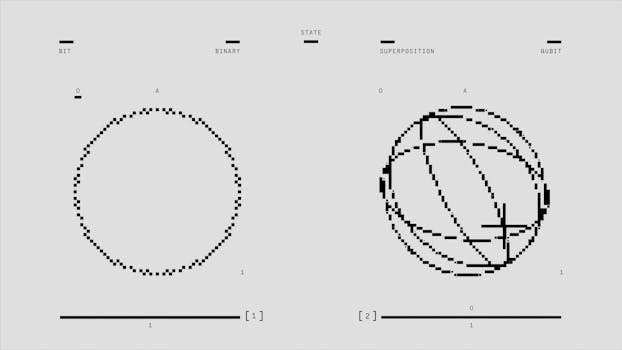
Unlike classical bits (0 or 1), qubits can exist in a superposition of both states. This 'both at once' property is fundamental to quantum computing's power.
2
Superposition: Many States at Once
Imagine a coin spinning in the air; it's neither heads nor tails until it lands. A qubit in superposition is like that spinning coin, holding multiple possibilities simultaneously.
3
Entanglement: Interconnected Qubits
Entangled qubits are intrinsically linked, meaning the state of one instantly influences the state of the other, no matter the distance. This connection amplifies computational power immensely.
4
Quantum Gates: Manipulating Qubits
Just as classical computers use logic gates, quantum computers use quantum gates to manipulate qubit states and create algorithms. These gates control superposition and entanglement.
Demystifying the Quantum Realm: Core Concepts for Beginners
Photo: Pachon in Motion / Pexels
To truly explain quantum computing simply, we must first grasp its foundational principles, which stem from the bizarre rules of quantum mechanics. Forget everything you know about traditional computers that rely on bits representing either a 0 or a 1. Quantum computers operate in a fundamentally different way, leveraging phenomena like superposition, entanglement, and quantum tunneling to perform calculations. The core building block here isn't the classical bit, but the 'qubit'. A qubit is revolutionary because, unlike a classical bit, it can represent a 0, a 1, or both simultaneously. This 'both at once' state is called superposition. Imagine a light switch that can be on, off, or in a state of being both on and off at the same time. While conceptually challenging, this capability allows a quantum computer to process vast amounts of information in parallel, exploring multiple possibilities simultaneously rather than sequentially.
Another mind-bending concept is entanglement. When two or more qubits become entangled, they become intrinsically linked, regardless of the physical distance separating them. The state of one entangled qubit instantly influences the state of the other, even if they are light-years apart. This phenomenon, famously dubbed 'spooky action at a distance' by Einstein, is not just a scientific curiosity; it's a powerful computational resource. Entanglement allows quantum computers to perform operations on multiple qubits simultaneously, creating a computational space that grows exponentially with each added qubit. This exponential growth is why quantum computers hold the promise of solving problems that are utterly intractable for even the most powerful classical supercomputers. Understanding these concepts – qubits, superposition, and entanglement – is the first crucial step in demystifying this cutting-edge technology. Without them, the true power and potential of quantum computing remain elusive. As we delve deeper, we'll see how these principles translate into practical applications that could revolutionize various industries, from medicine to finance. For a deeper dive into the broader tech landscape, explore how artificial intelligence is transforming industries alongside quantum advancements.
How Quantum Computers Work: Beyond the Binary
The operational mechanics of a quantum computer are vastly different from its classical counterpart. While a classical computer uses transistors to represent bits and logic gates to manipulate them, a quantum computer uses specialized hardware to create and control qubits. These qubits can be realized in various physical forms, such as trapped ions, superconducting circuits, or even photons, each with its own advantages and challenges. The ability to maintain qubits in a coherent superposition and entangled state is paramount, as any disturbance from the environment (known as decoherence) can cause them to lose their quantum properties and revert to classical bits, leading to errors. This fragility is one of the biggest engineering hurdles in building robust quantum computers.
Quantum algorithms are specifically designed to leverage superposition and entanglement to solve problems more efficiently than classical algorithms. Famous examples include Shor's algorithm, which can factor large numbers exponentially faster than classical algorithms (threatening current encryption methods), and Grover's algorithm, which can search unsorted databases quadratically faster. These algorithms don't just speed up existing processes; they enable entirely new ways of computation, allowing us to tackle problems that are simply beyond the reach of classical computing, regardless of how much processing power is thrown at them. The process involves initializing qubits into a superposition, applying a sequence of quantum gates to manipulate their states and induce entanglement, and finally measuring the qubits. The measurement process causes the qubits to collapse into a definite classical state (0 or 1), providing the computational result. Because quantum processes are probabilistic, multiple runs of an algorithm are often needed to determine the correct answer with high confidence. This iterative nature is another key difference from deterministic classical computations, highlighting the probabilistic heart of quantum mechanics at work in computing.
The Transformative Potential: Applications and Future Impact
The implications of quantum computing stretch across numerous sectors, promising to unleash unprecedented problem-solving capabilities. In medicine and materials science, quantum computers could revolutionize drug discovery and the development of new materials. Simulating molecular interactions at an atomic level, a task currently impossible for classical computers due to the exponential complexity, becomes feasible with quantum machines. This could lead to the design of highly effective drugs with fewer side effects, or the creation of materials with tailored properties for anything from superconductors to more efficient batteries. Imagine designing a new catalyst for carbon capture or finding the perfect protein folding structure to cure a disease – these are within quantum computing's grasp.
Another critical area is cryptography. While Shor's algorithm poses a significant threat to current public-key encryption standards like RSA, quantum computing also offers solutions. Quantum cryptography, particularly Quantum Key Distribution (QKD), provides theoretically unbreakable encryption methods based on the laws of physics, not mathematical complexity. This creates a new frontier for secure communication in a quantum-enabled world. Furthermore, in the realm of financial modeling, quantum computers could optimize complex portfolios, predict market fluctuations with greater accuracy, and develop more sophisticated risk assessment models. Logistics and supply chain optimization, artificial intelligence (especially machine learning), and even climate modeling stand to benefit immensely from the ability to process vast, interconnected datasets and explore combinatorial possibilities at speeds unimaginable today. The transition to a quantum-centric world is not just about faster calculations; it's about enabling entirely new paradigms of scientific discovery and technological innovation. It’s a journey that parallels the early days of classical computing, but with a far more profound impact on our understanding and manipulation of the physical world. Understanding how these powerful systems interact with existing technologies is crucial; explore more about the evolution of computing architectures to see where quantum fits in.
Challenges and Misconceptions: Navigating the Quantum Hype
Despite its immense promise, quantum computing is still in its nascent stages and faces significant challenges. One of the primary hurdles is decoherence, where the fragile quantum states of qubits are easily disturbed by external noise, leading to errors. Building and maintaining quantum computers requires extremely precise control over environmental factors, often necessitating super-cold temperatures (near absolute zero) or vacuum conditions. Scalability is another major issue; increasing the number of stable, interconnected qubits while maintaining their coherence is incredibly difficult. We are currently in the 'noisy intermediate-scale quantum' (NISQ) era, where quantum computers have a limited number of qubits and are prone to errors, making them useful for specific, small-scale problems rather than general-purpose computation.
It's also crucial to address common misconceptions. Quantum computers are not simply 'faster' versions of classical computers for all tasks. They excel at specific types of problems that involve searching vast solution spaces or simulating quantum systems, but they won't replace your laptop for browsing the internet or playing video games. They are specialized tools. Another misconception is that they will instantly break all encryption; while a threat, significant research is underway in post-quantum cryptography to develop new encryption standards resistant to quantum attacks. The development of quantum software and algorithms is also a significant challenge, requiring a new way of thinking and specialized programming expertise. The road to fully fault-tolerant, universal quantum computers is long, likely decades away, and involves overcoming fundamental physics and engineering obstacles. It's a journey marked by incremental progress, not overnight breakthroughs.
Key challenges include:
* **Decoherence:** Maintaining fragile quantum states.
* **Error Correction:** Developing robust methods to fix quantum errors.
* **Scalability:** Building quantum computers with many stable qubits.
* **Hardware Development:** Advancing qubit technologies (superconducting, trapped ion, etc.).
* **Algorithm Development:** Creating practical, real-world quantum algorithms.
* **Talent Gap:** Training a workforce skilled in quantum science and engineering.
Comparison
Feature
Quantum Computing
Classical Computing
High-Performance Computing (HPC)
Basic Unit
Qubit (0, 1, or both)
Bit (0 or 1)
Bit (0 or 1)
Processing Method
Superposition, Entanglement
Sequential, Parallel (limited)
Massive Parallel, Sequential
Problem Suitability
Optimization, Simulation, Cryptography
General-purpose, Data Processing
Complex Simulations, Big Data
Computational Power Growth
Exponential with qubits
Linear with bits/cores
Linear with cores/nodes
Energy Consumption
High (cooling, control)
Moderate
Very High
Maturity Level
Early-stage (NISQ)
Mature, Ubiquitous
Mature, Specialized
Future Impact
Revolutionary for specific tasks
Continued evolution
Continued evolution for large-scale classical problems
What Readers Say
★★★★★
"This article truly helps explain quantum computing simply, breaking down complex ideas like superposition into digestible concepts. It clarified many points I found confusing elsewhere."
Dr. Evelyn Reed · Boston, MA
★★★★★
"As someone new to quantum mechanics, this guide was incredibly helpful. The analogies made it much easier to grasp entanglement and its significance."
Marcus Chen · San Jose, CA
★★★★★
"I finally understand the difference between classical and quantum bits thanks to this article! It demystified the 'spooky action' and showed me the real-world applications in drug discovery."
Sarah Jenkins · Austin, TX
★★★★★
"While excellent for beginners, I would have appreciated a slightly deeper dive into the specific quantum gate operations. Still, a fantastic resource to explain quantum computing simply."
David Miller · Seattle, WA
★★★★★
"As a finance professional, the section on financial modeling potential was eye-opening. This article connected the dots between abstract physics and practical industry applications."
Lena Petrova · Chicago, IL
Frequently Asked Questions
What is the single most important concept to understand in quantum computing?
The most important concept is the 'qubit' and its ability to exist in a 'superposition' of multiple states simultaneously (0, 1, or both). This fundamental difference from classical bits allows quantum computers to process information in ways classical computers cannot, opening up possibilities for parallel computation and exploration of vast solution spaces.
Is quantum computing going to replace all classical computers?
No, quantum computing is not expected to replace classical computers for general-purpose tasks. Instead, it is a specialized tool designed to solve specific, highly complex problems that are intractable for even the most powerful classical supercomputers. Your laptop and smartphone are safe; quantum computers will serve as powerful accelerators for particular computational challenges.
How do I start learning quantum programming?
To start learning quantum programming, begin by understanding the foundational quantum mechanics concepts (qubits, superposition, entanglement). Then, explore quantum programming frameworks like IBM's Qiskit, Google's Cirq, or Microsoft's Q#. Many online courses, tutorials, and simulators are available to help you write your first quantum algorithms and experiment with quantum circuits.
How expensive are quantum computers, and can I buy one?
Quantum computers are incredibly expensive, costing millions of dollars to develop and maintain, and are not available for individual purchase. Access is typically provided through cloud-based quantum computing platforms offered by companies like IBM, Amazon, and Google, allowing researchers and developers to run experiments on real quantum hardware or simulators.
How does quantum computing compare to artificial intelligence (AI)?
Quantum computing is a type of computation, while AI is a field of computer science focused on creating intelligent machines. They are complementary; quantum computing can potentially accelerate and enhance certain AI algorithms, particularly in areas like machine learning, by processing larger datasets or exploring more complex models faster than classical methods. Quantum AI is an emerging field.
Who should be interested in learning about quantum computing?
Anyone interested in the future of technology, science, and problem-solving should learn about quantum computing. This includes researchers in physics, chemistry, and materials science, cybersecurity experts, financial analysts, AI developers, and anyone in industries that rely on complex simulations or optimization tasks. Understanding its potential is becoming increasingly important for innovators.
Are there any risks associated with quantum computing?
The primary risk discussed is its potential to break current public-key encryption standards, which secure much of our online communication. However, extensive research is ongoing in 'post-quantum cryptography' to develop new encryption methods resistant to quantum attacks. Other risks are largely theoretical at this stage, related to the ethical implications of unprecedented computational power.
What is the timeline for quantum computing becoming widely impactful?
While quantum computers are already solving niche problems, truly widespread, transformative impact is likely still decades away. We are currently in the 'noisy intermediate-scale quantum' (NISQ) era. The development of fault-tolerant, universal quantum computers capable of solving large-scale, general problems will require significant advancements in hardware stability, error correction, and algorithm development.
Ready to dive deeper into the quantum revolution? This guide has equipped you with the foundational understanding to explain quantum computing simply. Continue exploring its fascinating applications and stay ahead of the curve in this rapidly evolving technological frontier.