The Best Portable Power Banks for Travel: Stay Charged Anywhere
best portable power banks for travel

The Best Portable Power Banks for Travel: Stay Charged Anywhere

Unlock uninterrupted connectivity and productivity on your adventures with the ultimate portable charging solutions.

Find Your Perfect Power Bank

Key Takeaways

  • ✓ Capacity (mAh) is crucial: 10,000 mAh for smartphones, 20,000+ mAh for laptops/multiple devices.
  • ✓ USB-C Power Delivery (PD) offers faster charging for compatible devices.
  • ✓ Airline regulations limit power banks to 100Wh (approx. 27,000 mAh) in carry-on luggage.
  • ✓ Output ports (USB-A, USB-C) and wattage determine device compatibility and charging speed.

How It Works

1
Understand Your Needs

Assess the devices you'll charge (phone, tablet, laptop) and how many recharges you'll need. This determines the necessary capacity and output types.

2
Check Specifications

Look for capacity (mAh/Wh), output ports (USB-A, USB-C PD), charging speed (Watts), and physical size/weight. Ensure it meets airline regulations if flying.

3
Prioritize Features

Decide if fast charging, pass-through charging, built-in cables, or ruggedness are important for your travel style. Balance features with budget.

4
Purchase & Prepare

Once chosen, fully charge your new power bank before your trip. Always carry it in your carry-on luggage, never in checked baggage.

Why a Reliable Portable Power Bank is Your Ultimate Travel Companion

A smartphone connected to a charger lying on a wooden table indoors. Photo: Hasan Albari / Pexels
In our increasingly connected world, staying powered up while traveling is less of a luxury and more of a fundamental necessity. From navigating unfamiliar streets with GPS, capturing breathtaking photos, staying in touch with loved ones, or even getting some work done on the go, our devices are integral to the modern travel experience. Imagine being lost in a new city, your phone dead, unable to access your map or call for help. Or perhaps you're on a long-haul flight, wanting to finish that movie, only to find your tablet's battery icon flashing red. These scenarios, once common, are now easily avoidable with the right portable power bank. This isn't just about convenience; it's about peace of mind, safety, and maximizing your travel enjoyment. The best portable power banks for travel are more than just external batteries; they are compact, high-capacity energy reservoirs designed to meet the rigorous demands of life on the road. They come in various shapes, sizes, and capacities, each tailored to different types of travelers and their specific needs. For the light traveler relying solely on a smartphone, a slim 10,000 mAh bank might suffice. For the digital nomad juggling a laptop, tablet, and phone, a robust 20,000 mAh or even 27,000 mAh unit with Power Delivery (PD) capabilities becomes indispensable. The evolution of charging technology, particularly USB-C Power Delivery, has revolutionized what these devices can do, allowing for rapid charging of not just phones, but also power-hungry laptops and Nintendo Switches. This means less time tethered to a wall outlet and more time exploring, experiencing, and enjoying your journey. Furthermore, many modern power banks incorporate advanced safety features, protecting your devices from overcharging, overheating, and short-circuiting, adding another layer of reliability. When selecting the best tech gadgets for travel, a portable power bank should always be at the top of your list. It's an investment in uninterrupted connectivity, ensuring that whether you're camping in the wilderness, navigating a bustling metropolis, or enduring a lengthy layover, your essential electronics remain operational. Don't underestimate the power of being prepared; a dead battery can turn a minor inconvenience into a major headache. A high-quality portable power bank is your assurance against such disruptions, allowing you to focus on the adventure at hand.

Decoding Capacity, Charging Speed, and Airline Regulations for Travel Power Banks
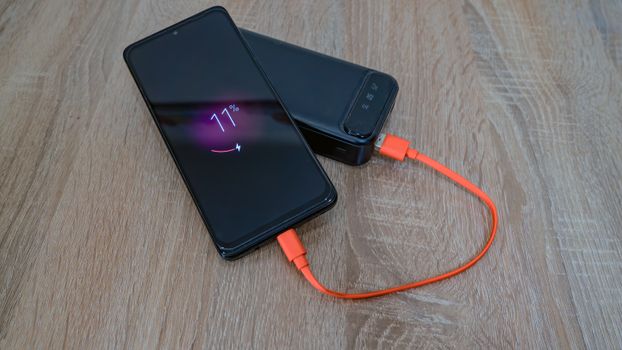
A smartphone charging from a power bank with an orange cable on a wooden table. Photo: Eleonora Vokueva / Pexels
When venturing into the world of portable power banks for travel, three critical factors demand your attention: capacity, charging speed, and airline regulations. Understanding these aspects is paramount to choosing a device that genuinely meets your travel needs and avoids any potential headaches, especially at airport security. Capacity, measured in milliampere-hours (mAh), dictates how many times your power bank can recharge your devices. As a general rule, a 10,000 mAh power bank can typically recharge a standard smartphone 2-3 times. If you're planning shorter trips or only need to top up your phone and earbuds, this might be perfectly adequate. However, for extended journeys, multiple devices, or charging larger gadgets like tablets and laptops, you'll want to aim for 20,000 mAh or higher. Some power banks reach up to 27,000 mAh, offering substantial power reserves for the most demanding users. Next, let's talk about charging speed, which is primarily determined by wattage (W) and the type of charging ports. The advent of USB-C Power Delivery (PD) has been a game-changer. USB-C PD ports can deliver significantly higher wattage compared to traditional USB-A ports, enabling rapid charging for compatible smartphones, tablets, and even many modern laptops. For instance, a power bank with a 60W or 100W USB-C PD output can charge a MacBook Pro almost as quickly as its wall charger. Always check the wattage output of the power bank and the input wattage required by your devices to ensure optimal charging speeds. A power bank with multiple output ports (e.g., one USB-C PD and two USB-A) offers versatility, allowing you to charge several devices simultaneously, albeit potentially at reduced speeds if the total output is shared. Finally, and perhaps most crucially for air travel, are airline regulations. The International Air Transport Association (IATA) guidelines, adopted by most airlines worldwide, stipulate that lithium-ion batteries (which power banks are) must be carried in carry-on luggage only, never in checked baggage, due to fire risk. Furthermore, there are capacity limits. Power banks with a capacity of up to 100 Watt-hours (Wh) are generally permitted without special approval. For reference, 100 Wh is approximately equivalent to 27,000 mAh (calculated as Wh = (mAh * V) / 1000, assuming a typical 3.7V battery). Power banks between 100 Wh and 160 Wh require airline approval, and anything above 160 Wh is typically forbidden. Always look for the Wh rating printed on the power bank itself to avoid any issues at security checkpoints. Being informed about these regulations ensures a smooth journey and keeps your essential power source with you when you need it most. Prioritizing these factors will help you select a power bank that not only keeps your devices alive but also travels seamlessly with you.

Top Features and Brands to Consider for the Best Portable Power Banks for Travel
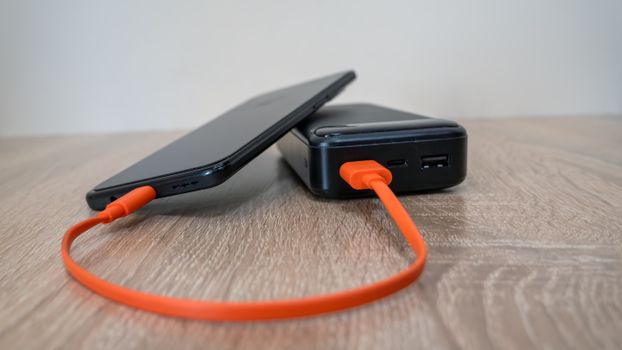
A smartphone charging via an orange cable connected to a power bank on a wooden surface. Photo: Eleonora Vokueva / Pexels
Beyond capacity and charging speed, several advanced features can significantly enhance the utility and convenience of your travel power bank. Understanding these can help you differentiate between good and great options. One such feature is pass-through charging, which allows the power bank to charge itself while simultaneously charging your connected devices. This is incredibly useful when you have limited wall outlets, as you can charge both your power bank and your phone overnight using a single adapter. Another valuable feature is wireless charging, often indicated by Qi compatibility. While typically slower than wired charging, it offers unparalleled convenience for compatible smartphones and earbuds, eliminating the need for extra cables. For the adventurous traveler, rugged and waterproof designs are paramount. These power banks are built to withstand drops, dust, and splashes, making them ideal for hiking, camping, or beach trips where standard electronics might fail. Some even include built-in flashlights, a minor but often appreciated addition in emergencies or low-light situations. Smart display screens, though not essential, provide real-time information on remaining battery percentage, charging input/output wattage, and estimated charge times, offering a clear overview of your power status. Integrated cables are another thoughtful design element, reducing the clutter of carrying multiple separate cables for different devices. Many power banks now come with built-in USB-C, Lightning, or micro-USB cables, ensuring you always have the right connection at hand. When it comes to reputable brands, several companies consistently deliver high-quality, reliable portable power banks. Anker is often considered the industry leader, known for its extensive range, robust build quality, and innovative charging technologies like PowerIQ and VoltageBoost. Their PowerCore series offers options from compact 10,000 mAh units to powerful 26,800 mAh models. RAVPower and AUKEY are other strong contenders, offering competitive alternatives with excellent performance and often more budget-friendly price points. These brands frequently incorporate USB-C PD and Quick Charge technologies, ensuring fast and efficient power delivery. Goal Zero caters to the outdoor and adventure market, specializing in rugged solar-compatible power banks and portable power stations, which are perfect for off-grid travel. For those seeking premium design and performance, brands like Mophie and ZMI also offer excellent choices, often with sleek aesthetics and advanced features. Ultimately, the best portable power bank for you will depend on your specific travel style, the devices you carry, and your budget, but these brands provide a solid starting point for your research. Don't forget to check out essential travel tech accessories to complement your power bank.

Crucial Tips for Maximizing Your Power Bank's Lifespan and Travel Safety
Three smartphones connected to chargers on a wooden surface, showcasing modern technology Photo: Stanley Ng / Pexels
Owning a portable power bank is only half the battle; knowing how to properly use and care for it ensures longevity, optimal performance, and safe travel. Here are some crucial tips to get the most out of your investment and avoid common pitfalls: * **Charge It Fully Before Every Trip:** This might seem obvious, but many travelers forget this essential step. A fully charged power bank is a ready power bank. Always top it off the night before you depart. * **Store It Properly:** When not in use, store your power bank in a cool, dry place, away from direct sunlight and extreme temperatures. Avoid leaving it in a hot car, as excessive heat can degrade the battery cells and pose a safety risk. * **Avoid Over-Discharging:** Try not to let your power bank completely drain to 0% regularly. Lithium-ion batteries have a longer lifespan if they are kept between 20% and 80% charge. Occasional full cycles are fine, but constant deep discharges reduce overall battery health. * **Use Quality Cables:** Cheap or damaged charging cables can significantly slow down charging speeds and can even be a fire hazard. Invest in high-quality, durable cables from reputable brands that match your power bank's output and your device's input. * **Understand Airline Regulations (Again!):** As mentioned, always carry your power bank in your carry-on luggage. Never put it in checked baggage. If your power bank doesn't clearly state its Wh rating, it might be confiscated. Take a photo of the specifications or keep the packaging with you if you're unsure. * **Protect It from Physical Damage:** While some power banks are rugged, none are indestructible. Avoid dropping it, exposing it to water (unless it's explicitly waterproof), or placing heavy objects on it. A protective case can be a wise investment. * **Don't Charge and Discharge Simultaneously (Unless Pass-Through Supported):** Unless your power bank explicitly supports pass-through charging, avoid using it to charge a device while it itself is being charged. This can put undue stress on the battery and internal circuitry. * **Recycle Responsibly:** When your power bank eventually reaches the end of its life, do not throw it in regular trash. Lithium-ion batteries must be recycled at designated electronics recycling centers to prevent environmental harm. By following these guidelines, you'll not only extend the life of your portable power bank but also ensure a safer, more reliable charging experience throughout all your travels. A little care goes a long way in maintaining this indispensable travel accessory.

Comparison

FeatureAnker PowerCore III Elite 25600RAVPower PD Pioneer 20000mAhGoal Zero Sherpa 100PD
Capacity25600 mAh (94.72Wh)20000 mAh (74Wh)25600 mAh (94.72Wh)
Max USB-C PD Output87W60W100W
USB-A Ports2 (18W shared)1 (18W)2 (12W shared)
Wireless Charging✓ (15W)
Pass-Through Charging
Weight1.2 lbs0.8 lbs1.5 lbs
Airline Approved
Best ForLaptop & multiple devicesPhones & tabletsLaptops & outdoor use

What Readers Say

"This Anker PowerCore is truly one of the best portable power banks for travel. I used it on a two-week trip through Europe and it kept my phone, tablet, and even my small laptop charged without a hitch. Never had to worry about finding an outlet."

Sarah J. · Austin, TX

"The RAVPower PD Pioneer is a game-changer for my business trips. It's compact enough for my carry-on and charges my MacBook Pro quickly with the USB-C PD. Absolutely essential for staying productive on the go."

Mark D. · Seattle, WA

"I bought the Goal Zero Sherpa for a camping trip, and it exceeded expectations. The wireless charging was a huge plus, and it survived a few bumps and splashes. It kept my phone and headlamp charged for days, a fantastic result."

Emily R. · Denver, CO

"While the Anker PowerCore is a bit heavier than I expected, its charging capacity and speed make it worth the extra weight. It handled my phone and drone battery recharges perfectly during my vacation, so I can't complain too much."

David K. · Miami, FL

"As a photographer, my camera and phone batteries drain fast. This portable power bank for travel (Anker) has been a lifesaver on shoots, especially when I'm away from power for extended periods. It's robust and utterly reliable."

Lisa G. · Chicago, IL

Frequently Asked Questions

What is the maximum capacity power bank I can take on an airplane?

Most airlines follow IATA guidelines, allowing power banks up to 100 Watt-hours (Wh) in carry-on luggage without special approval. This typically translates to approximately 27,000 mAh for a standard 3.7V battery. You can usually take two power banks between 100Wh and 160Wh with airline approval.

Is it safe to charge my phone overnight with a power bank?

Yes, reputable power banks include built-in safety features that prevent overcharging, overheating, and short-circuiting. They will automatically stop charging once your device is full, making it generally safe to leave your phone connected overnight.

How do I calculate the Watt-hours (Wh) of my power bank from mAh?

You can calculate Watt-hours (Wh) using the formula: Wh = (mAh * V) / 1000, where V is the nominal voltage of the power bank's internal battery, typically 3.7V. For example, a 20,000 mAh power bank would be (20000 * 3.7) / 1000 = 74 Wh.

Are more expensive power banks always better value?

Not always. While premium brands often offer superior build quality, faster charging speeds, and advanced features like pass-through charging or wireless charging, there are many mid-range options that provide excellent value for money. Focus on capacity, output ports, and specific features you need, rather than just price.

What's the difference between Quick Charge and Power Delivery (PD)?

Quick Charge (QC) is a fast-charging technology primarily developed by Qualcomm, often found in Android phones. Power Delivery (PD) is an open standard that uses USB-C connectors and cables to deliver higher power, supporting a wider range of devices including laptops, and is generally more versatile and powerful than QC.

Who should prioritize a rugged or waterproof power bank?

Travelers who frequently engage in outdoor activities such as hiking, camping, kayaking, or those visiting humid, dusty, or unpredictable environments should prioritize a rugged and/or waterproof power bank. These models offer enhanced durability and protection against the elements.

Can a power bank damage my phone battery?

No, a high-quality, reputable power bank will not damage your phone battery. They incorporate smart chip technology to regulate voltage and current, ensuring safe charging tailored to your device's needs. Only extremely cheap, unbranded, or faulty power banks pose a risk.

What is the future of portable power banks for travel?

The future likely involves even higher power densities (more capacity in smaller sizes), faster charging speeds with wider adoption of GaN (Gallium Nitride) technology, integrated smart features like app control, and increased sustainability through more eco-friendly materials and advanced recycling programs.

Don't let a dead battery cut short your adventures. Invest in one of the best portable power banks for travel today and ensure you stay connected, navigated, and entertained wherever your journey takes you. Explore our recommendations and choose the perfect power companion for your next trip.

Topics: best portable power banks for traveltravel power bankportable charger travelUSB-C power bankairplane safe power bank
Leo List
Brampton weed
Adultwork